Home Workout Basics: Space, Equipment and Getting Started
Home workouts have an image problem. Search for them and you will find either people with a garage full of equipment or thirty-day challenges that assume you can already do twenty push-ups. Neither is where most beginners are. This guide is about the unglamorous basics: how much space you actually need, what (if anything) is worth buying, what a first session looks like, and how to get through the first month without hurting yourself or giving up.
What a home workout is for
Adult activity guidelines from the CDC and the NHS have two parts: at least 150 minutes a week of moderate aerobic activity, and muscle-strengthening activity for all the major muscle groups on at least two days a week (CDC, NHS). Walking takes care of the first part for a lot of people. Home workouts are the simplest way to cover the second, which is the part beginners most often leave out. The CDC counts body-weight exercises and resistance bands as muscle-strengthening activity, so a living-room session is fully legitimate (CDC: What counts).
Space: less than you think
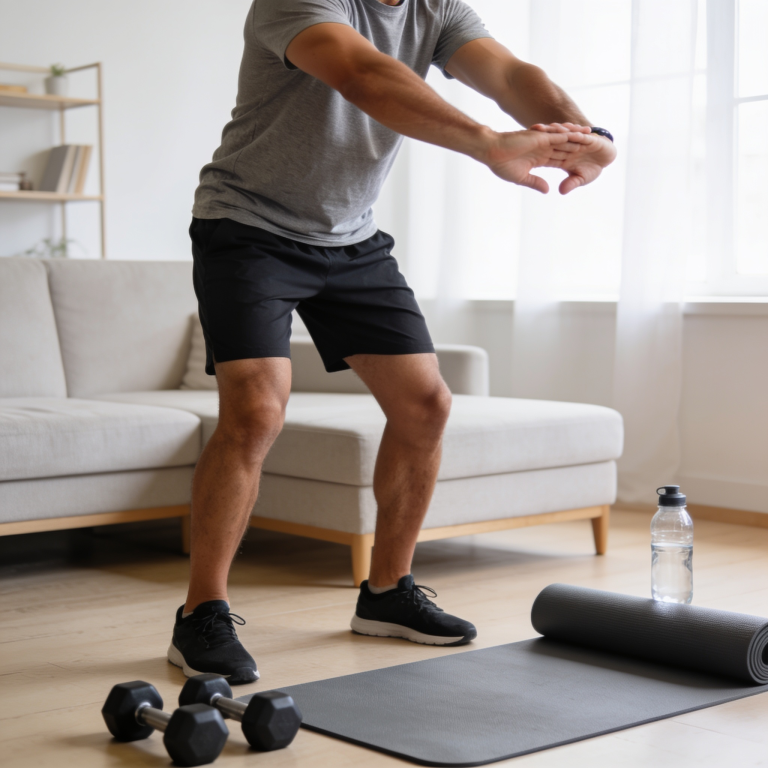
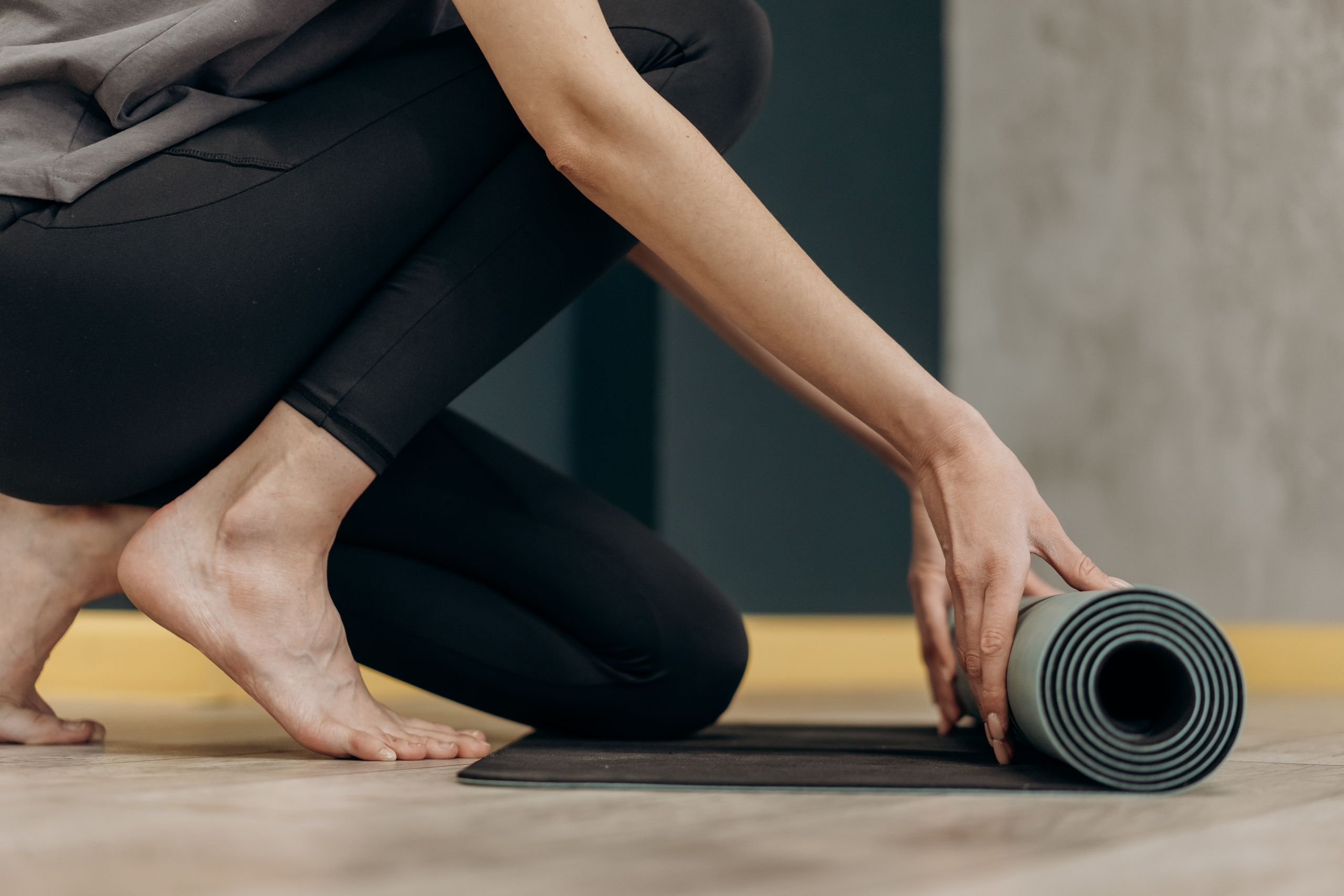
You need a clear rectangle roughly two metres by one metre, about the footprint of a yoga mat, with enough headroom to raise your arms. That is it. A hallway, the end of a bed, a corner of the kitchen. If you can lie down on the floor with your arms out and not hit furniture, you have enough room for every exercise in this guide.
A few things about the space itself:
- Floor: carpet or a mat is kinder on knees and hands than bare tile. A folded towel works for knee-down exercises if you do not have a mat.
- A sturdy chair or step: the most useful “equipment” you already own. It makes squats easier (sit to stand), push-ups easier (hands on the seat), and dips and step-ups possible.
- A wall: for wall push-ups, wall sits, and balance support.
- Somewhere to put a phone or tablet at eye level if you follow along with videos.
Equipment: start with nothing, then maybe bands
You can meet the strength guideline with body weight alone. Squats, push-up variations, lunges, glute bridges, planks and step-ups cover the major muscle groups the CDC lists: legs, hips, back, abdomen, chest, shoulders and arms. Buying equipment before you have done a month of body-weight sessions mostly buys you a reason to feel guilty.
When you do want to add something, resistance bands are the sensible first purchase: inexpensive, small, and they make pulling exercises (rows, pull-aparts) possible, which are hard to do with body weight alone at home. Our Beginner’s Guide to Resistance Bands explains the types and what to look for. After that, a pair of adjustable dumbbells or a kettlebell is the usual next step, but there is no hurry.
Your first session
The CDC suggests 8 to 12 repetitions of each exercise as one set, doing at least one set and working up to two or three, with the effort high enough that by the end of the set it is hard to do another repetition (CDC). For a true beginner, “hard to do another” can mean a wall push-up rather than a floor push-up. The version you choose should let you move with control for the whole set.
A first session, about 15 minutes:
- Warm up, 3 minutes: march on the spot, arm circles, gentle torso twists, five slow sit-to-stands.
- Sit-to-stand from a chair (legs, hips): 8–12 reps. Make it harder by not using your hands, or by hovering just above the seat instead of sitting.
- Wall or incline push-up (chest, shoulders, arms): 8–12 reps. Hands on a wall is easiest; hands on a kitchen counter, then a chair seat, then the floor, each step harder.
- Glute bridge (hips, back of thighs): lie on your back, knees bent, lift your hips, 8–12 reps.
- Band row or towel row (back): with a band anchored around your feet or a door, pull your hands to your ribs, 8–12 reps. Without a band, hold a towel taut and pull your elbows back and shoulder blades together for 8–12 slow reps.
- Plank or dead bug (core): hold a plank on knees or toes for 15–30 seconds, or lie on your back and slowly extend opposite arm and leg, 6–8 each side.
- Cool down, 2 minutes: stand and gently stretch the front of the thighs, calves, and chest.
Do one set of each on your first day. That is a complete, guideline-meeting strength session. It will feel too easy for some people. Good; add a second set next time.
A simple first month
Consistency matters more than variety in the first month. Repeating the same session lets you see yourself improve, which is more motivating than novelty.
- Weeks 1–2: the session above, one set of each exercise, on two non-consecutive days (for example Tuesday and Friday). Walk on the other days.
- Weeks 3–4: two sets of each exercise, still two days a week. If any exercise stays easy, move to the next harder version (wall push-up to counter push-up, sit-to-stand to a slower sit-to-stand without hands).
- After a month: add a third day, or a third set, or a couple of new movements such as step-ups and side-lying leg raises. Any one of those is enough change for the next month.
Leave at least a day between strength sessions for the same muscles so they can recover. Walking on rest days is fine and encouraged.
Soreness, pain and when to stop
Dull, general muscle soreness that appears a day or two after a session and fades within a few days is a normal response to new work, and it lessens as you adapt. Sharp or stabbing pain during an exercise, pain in a joint rather than a muscle, pain that gets worse as you continue, chest discomfort, or dizziness are different: stop, and seek advice if it does not settle. The NHS advises talking to your GP before starting if you have not exercised for some time, and the CDC recommends people with chronic conditions consult a healthcare professional about appropriate activity. This site provides general information only.
Common questions
Do I have to do it in the morning?
No. The CDC’s suggestion for people who lack energy is to schedule activity for the time of day you feel most energetic (CDC: Overcoming barriers). Two fifteen-minute sessions at 8 pm are worth exactly as much as two at 6 am.
Is fifteen minutes really enough?
For the muscle-strengthening part of the guidelines, a session that works the major muscle groups with enough effort counts, regardless of length. Longer sessions become useful once you are doing multiple sets and more exercises.
Should I follow videos?
Follow-along videos are useful for learning movements and for company, and there is no shame in using them indefinitely. Just check that the level really is beginner: if you cannot do the movements with control, find an easier one rather than pushing through.
What about cardio at home?
Marching, stair climbing, dancing and skipping all count as aerobic activity, and the CDC lists stair climbing and dance as good indoor options for bad weather. Most beginners find it simpler to get their aerobic minutes from walking and use home sessions for strength, but either arrangement works.
The takeaway
You need a mat-sized patch of floor and a chair. One set each of six basic movements, twice a week, meets the strength guideline. Add a second set before you add anything else. For how this fits with walking and habit-building, read the Beginner Fitness Guide, and if you keep meaning to start but never do, How to Build an Exercise Habit Around a Busy Schedule is written for you.
Sources
- CDC, Adult Activity: An Overview
- CDC, What Counts as Physical Activity for Adults
- CDC, Overcoming Barriers to Physical Activity
- NHS, Physical activity guidelines for adults aged 19 to 64
Content on Fitness With Fun is for general educational purposes and is not a substitute for personalized advice from a qualified healthcare professional.